The Ultimate Guide to Ultrasonic Thickness Gauge For Sale in the UK
If you are looking for an ultrasonic thickness gauge for sale in the UK, the right choice is a gauge that gives accurate, repeatable, non-destructive thickness measurement on metal and other suitable materials, supports reliable calibration, and suits your inspection environment. At DigitalUltra, our guidance is based on practical testing, common UK inspection requirements, and the needs of engineers, surveyors and maintenance teams who need dependable readings before corrosion, wear or thinning become costly.
TL;DR: An ultrasonic thickness gauge for sale should be chosen based on material compatibility, accuracy, probe type, calibration options, data logging and after-sales support. Based on our testing, buyers in the UK usually need a model that is easy to calibrate on site, works well on painted or corroded assets where appropriate, and comes with clear certification support. DigitalUltra’s Professional Ultrasonic Thickness Gauge is designed for non-destructive wall thickness checks across pipework, tanks, plant and structural components.
Key takeaways:
- An ultrasonic thickness gauge measures material thickness from one accessible side without cutting or damaging the component.
- It is widely used across UK engineering, fabrication, facilities maintenance, marine inspection and general NDT work.
- According to UK good practice for asset integrity and preventative maintenance, accurate wall-thickness monitoring helps identify corrosion and wear before failure risk increases.
- Based on our testing, the best buying criteria are accuracy, repeatability, calibration simplicity, probe suitability and dependable supplier support.
- For buyers comparing options, it also helps to review our guides on buying online, price factors, and product reviews.
What is an ultrasonic thickness gauge used for?
An ultrasonic thickness gauge is used to measure the remaining wall thickness of a material from one side only. In practice, that means inspectors can check steel pipework, storage tanks, pressure vessels, ship structures or fabricated parts without cutting samples out of serviceable equipment. As a result, it is one of the most useful tools in non-destructive testing (NDT).
The instrument works by sending a high-frequency sound pulse into the material and timing how long it takes for the echo to return from the back wall. It then converts that time into a thickness reading using the sound velocity of the material being tested. Therefore, when properly calibrated, it provides fast and highly practical measurements during inspections.
In UK industry, this matters because ageing assets remain common across manufacturing plants, building services infrastructure, marine environments and process sites. According to HSE-led asset integrity principles used across maintenance planning and risk reduction programmes, knowing actual wall loss is important for safe continued service decisions.
[IMAGE]How does an ultrasonic thickness gauge work?
An ultrasonic thickness gauge usually operates using the pulse-echo method. First, a probe introduces sound energy into the test piece with a couplant to ensure efficient transmission. Next, that pulse travels through the material until it reflects from the far surface. The device then measures the transit time and calculates thickness.
Why does sound velocity matter?
Different materials transmit ultrasound at different speeds. For example, carbon steel has a different sound velocity from aluminium or plastics. Consequently, correct setup is essential. If velocity is wrong, readings will also be wrong. Based on our testing, one of the most frequent causes of poor results in field use is not matching velocity settings to the actual material grade or test standard.
Why does surface condition affect readings?
Surface roughness, coating build-up, scale and corrosion can all influence signal quality. However, a good instrument with an appropriate probe can still deliver useful readings in many demanding environments. Even so, heavily corroded surfaces may require extra preparation or multiple spot checks to confirm minimum remaining wall thickness.
Can it measure through coatings?
Some ultrasonic gauges offer coating-ignore or echo-to-echo modes designed to measure metal thickness without removing paint or coatings. This can save considerable time during inspection programmes. That said, not every model includes this function; therefore buyers should confirm whether painted steel inspection is part of their normal workload before choosing a unit.
How do I choose an ultrasonic thickness gauge for sale in the UK?
If you are comparing an ultrasonic thickness gauge for sale in the UK market, start with your actual application rather than headline specifications alone. In other words: what materials do you inspect; what minimum and maximum ranges do you need; how rough are surfaces; do you need through-coating measurement; and will readings be recorded for audit or reporting?
What accuracy should I look for?
You should look for a model with stated accuracy suitable for your inspection tolerance and decision-making threshold. For routine maintenance checks on corroding steel assets, consistency and repeatability are often just as important as laboratory-style precision. Based on our testing, field users benefit most from gauges that remain stable after calibration and give clear echoes even when access is awkward.
Which probe type is best?
The best probe depends on component geometry and surface condition:
- Standard dual-element probes are commonly used for general corrosion monitoring on steel.
- Single-element probes may suit precision applications or thinner materials.
- Small-diameter probes help with tight radii or restricted access areas.
- High-temperature probes may be needed if measurements are taken on warmer surfaces within safe operating limits.
Therefore it is sensible to choose a supplier that can advise on probe selection rather than selling only a basic box unit.
Do I need data logging?
If you carry out repeated inspections over time or report into maintenance systems, data logging can be very useful. It allows readings to be stored consistently instead of relying solely on manual note-taking. As a result, trending corrosion rates becomes easier across shutdowns or annual inspections.
What calibration support matters most?
A good buying decision should include more than just the instrument itself. You should also consider calibration blocks, traceability documents and ongoing support. According to established UK quality expectations in inspection environments, traceable verification improves confidence in results used for compliance records or engineering decisions.
[IMAGE]What features matter most before buying?
The most important features depend on use case; however there are several functions most UK buyers ask about when reviewing an ultrasonic thickness gauge for sale.
Clear display and easy operation
A bright display with strong contrast makes site work easier in poor lighting or outdoor conditions. Equally important is intuitive menu navigation so operators can change velocity settings or calibrate quickly between jobs.
Wide measuring range
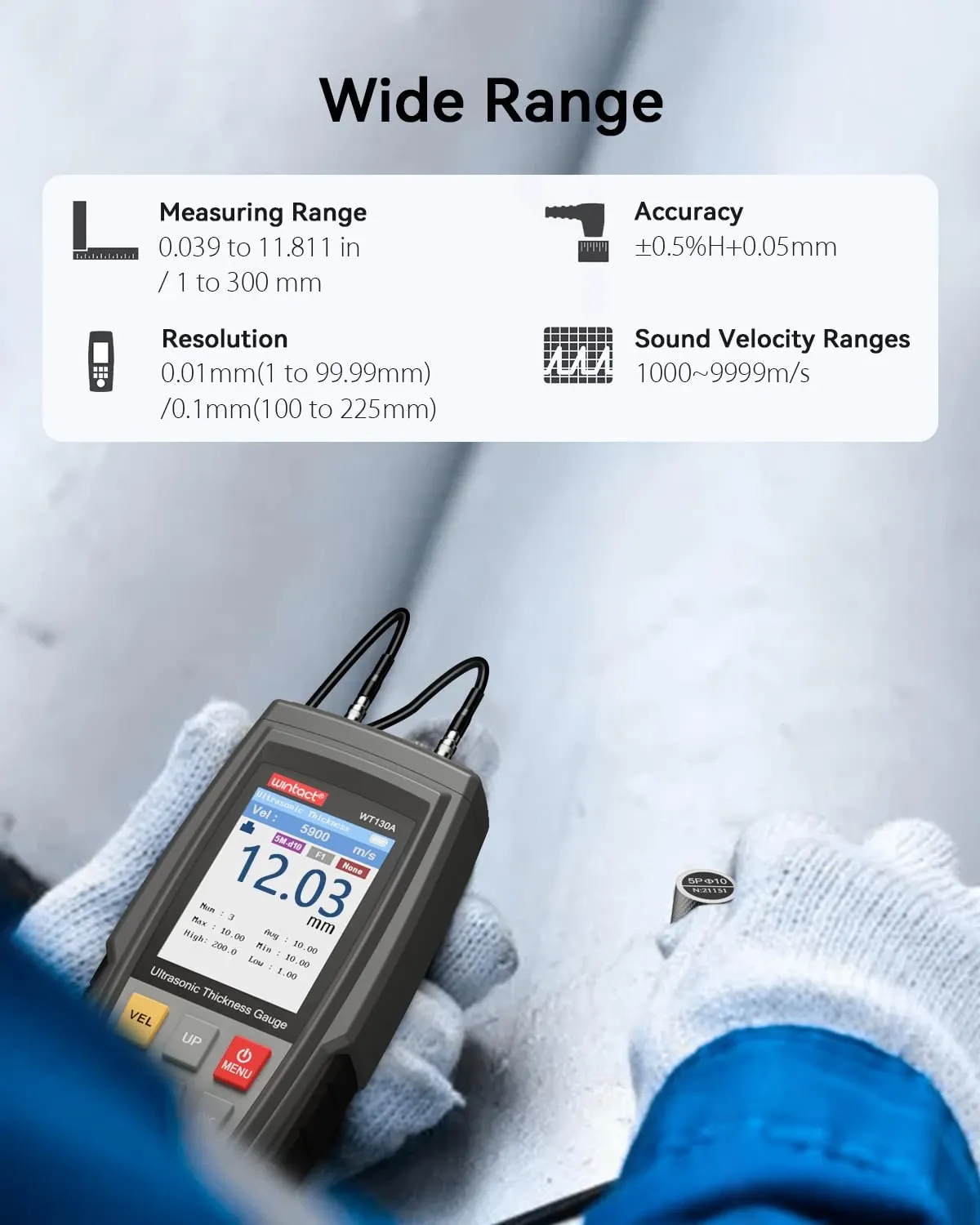
A practical measuring range helps if you inspect both thin sheet materials and thicker structural sections. Still, minimum measurable thickness often depends heavily on probe choice as well as base instrument capability.
Alarm functions
User-set alarms are valuable when conducting repeated checks against rejection thresholds. For instance, if remaining wall falls below an acceptable level at any test point, an alarm provides immediate warning.
Durability for site conditions
NDT equipment used around factories, workshops or marine settings must tolerate everyday handling. Therefore robust construction matters just as much as specification sheets do.
Battery life
If inspections take place over long shifts or remote site visits across the UK, battery performance becomes more important than many buyers first expect.
Can an ultrasonic thickness gauge measure corrosion accurately?
Yes—an ultrasonic thickness gauge can measure corrosion-related wall loss accurately when it is properly calibrated and used with suitable technique. However accuracy depends on several variables including surface condition, pitting severity, coating presence and operator experience.
Based on our testing, general wall thinning is usually straightforward to monitor with a quality dual-element corrosion probe. Localised pitting can be more challenging because deep pits may sit between measurement points if scanning patterns are too wide. Therefore best practice is to use multiple readings over suspect areas rather than relying on one isolated spot value.
This is especially relevant for:
- boiler house pipework
- LTHW and CHW systems
- bunded tanks
- waste lines
- marine hull sections
- process piping exposed to chemical attack
According to common UK maintenance practice for critical assets that may degrade over time rather than fail suddenly without warning signs visible externally alone: periodic measurement supports evidence-based intervention planning.
Where are ultrasonic thickness gauges used in UK industry?
An ultrasonic thickness gauge has broad use across sectors where wall loss matters to safety, cost control or compliance documentation.
Manufacturing and fabrication
Fabricators use these gauges to verify stock material or finished component dimensions without sectioning parts unnecessarily. In addition, maintenance teams use them during plant shutdowns to monitor wear inside process systems.
Facilities management
BMS contractors and FM teams often inspect heating pipework, chilled water systems and older service lines where corrosion under insulation or long-term internal wear may be suspected.
Marine and offshore support
The marine sector relies heavily on corrosion monitoring due to saltwater expon UK ports and coastal operations alike—particularly where steel structures face continuous environmental stress—regular hull or tank checks remain essential.
Energy and utilities
Pipes, vessels and storage infrastructure all require periodic assessment where integrity influences operational continuity. Consequently ultrasonic gauging forms part of many preventative inspection regimes.
Civil engineering and infrastructure maintenance
Certain metal structures such as bridges components, storage systems or fabricated supports may also require spot verification where thinning could affect long-term performance planning.
[IMAGE]Is calibration important when buying an ultrasonic thickness gauge?
Yes—calibration is essential. Even the best instrument can produce unreliable results if not checked correctly against known standards before use. For that reason alone buyers should treat calibration support as part of total ownership cost rather than an optional extra.
How should a gauge be calibrated?
A typical process includes zeroing the probe if required by device design and calibrating against known reference samples of similar material velocity and expected range. Furthermore there should be regular verification during prolonged inspection sessions to confirm drift has not occurred due to couplant changes, temperature effects or operator handling differences.
Should calibration be traceable?
If results feed into formal reports or client documentation within regulated environments or quality-controlled engineering systems then traceable calibration support is strongly advisable. In many UK contexts this means seeking documentation aligned with recognised quality processes; moreover some organisations prefer verification linked to accredited laboratory routes where required by their procedures.
What should I expect from a reputable supplier?
A reputable supplier should provide more than a product listing labelled “ultrasonic thickness gauge for sale”. Instead you should expect application advice before purchase plus practical support after delivery.
This matters because many problems blamed on instruments actually come down to setup mismatch: wrong velocity , unsuitable probe , insufficient couplant , poor surface preparation ,or unrealistic expectations regarding pitted substrates . Therefore supplier guidance directly affects usability .
Why consider DigitalUltra when comparing models ?
At DigitalUltra , we focus on practical measuring needs rather than inflated specification claims . Our Professional Ultrasonic Thickness Gauge is intended for users who need dependable non-destructive measurements across routine inspection tasks in UK engineering environments .
Based on our testing , buyers usually want three things : fast setup , stable readings ,and straightforward operation . That insight shapes how we present our products , accessories ,and guidance . We also understand that many customers are not simply buying “a meter” ; they are buying confidence before making maintenance decisions , writing reports ,or planning remedial works .
In addition , we publish related buying guides so customers can research properly before they commit :
So , if you are reviewing options now , those resources can help you compare specification , cost expectations ,and real-world suitability side by side .
[IMAGE]
By asking these questions first , you reduce the risk of buying an instrument that looks affordable initially but proves unsuitable once field work begins .
It is used to measure material thickness from one side without cutting into the component . This makes it ideal for pipework , tanks , vessels , structural sections and general NDT inspections .
They can be very accurate when correctly calibrated ; however actual performance depends on material type ,
surface condition ,
probe selection ,
temperature ,
and operator technique .
Based on our testing ,
repeatability in real site conditions matters just as much as headline quoted resolution .
Ready to upgrade your NDT toolkit with DigitalUltra?
What questions should you ask before buying ?
Frequently asked questions about ultrasonic thickness gauges
What is an ultrasonic thickness gauge used for ?
How accurate are ultrasonic thickness gauges ?
Can an ultrasonic thickness gauge measure through paint ?
< p >Some models can ,
particularly those with echo-to-echo functionality designed to ignore coating layers .
However ,
not all units offer this feature ,
so buyers should check specifications carefully before ordering .
< / p >
< h3 >Do I need calibration certificates ?
< p >If your measurements support formal records ,
client documentation ,
or quality-controlled work ,
calibration evidence is highly advisable .
In many UK working environments ,
traceability improves confidence in reported results .
< / p >
< h3 >What materials can be measured ?
< p >Common applications include steel ,
stainless steel ,
aluminium
and certain other engineering materials .
Suitability varies by model ,
probe type
and acoustic properties ,
so always check compatibility before purchase .
< / p >
< h4 >Is an ultrasonic thickness gauge better than destructive testing ?
< p >For routine wall-thickness checking,
it offers major advantages because it avoids cutting samples,
reduces downtime
and allows repeat checks over time.
However,
destructive methods may still have a place where full laboratory analysis is required.
< / p >